
From fast-food outlets and commercial kitchens to public plazas, fat and grease stains are a common sight. Cooking oils and food residues don’t just look bad — they seep into surfaces, become slippery hazards, and even start to smell if left untreated. Over time, they can break down the very materials they’ve stained.
The challenge is that grease bonds strongly to surfaces, especially porous ones like brick, stone, and concrete. Hot water alone won’t shift it. The safest and most effective method combines mild chemicals to break down grease molecules with controlled low-pressure steam to flush everything away and sanitise the surface. Here’s how it works across different materials.
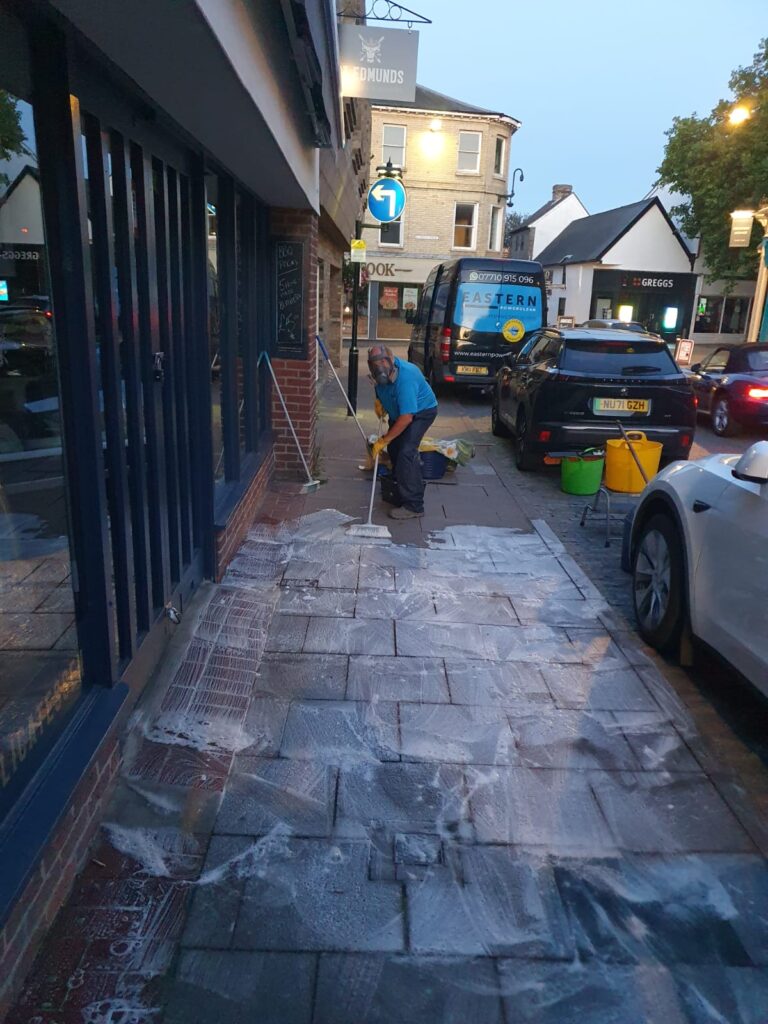

Brick and Stone: Porous and Stain-Holding
Brickwork, limestone, and sandstone soak up oils quickly. Once grease gets inside, it oxidises and darkens, making stains very stubborn.
– Common problems: Oils seep deep into pores and mortar joints. Everyday detergents only clean the surface, leaving ghost stains.
– How to clean it safely: Apply mild detergents or diluted alkaline degreasers to break down fats. For deeper stains, use an absorbent poultice made with clay or cellulose to draw the oil out. Finish with steam at 100–120 °C to flush and disinfect.
– What to avoid: Strong caustic chemicals (like caustic soda), solvents (like petrol or acetone), or abrasive blasting. These don’t solve the problem and often make it worse.
Concrete and Pavers: Tough but Oil-Absorbing
Concrete slabs and pavers are common in public spaces and outdoor eating areas. They’re durable, but they absorb oils just as easily as stone.
– Common problems: Dark stains that resist scrubbing, slippery surfaces, and oils binding with the cement matrix.
– How to clean it safely: Use dilute alkaline degreasers to break down the oil. For stubborn spots, clay poultices help pull grease out. Follow with superheated steam at 110–130 °C to finish the job and sanitise the surface.
– What to avoid: Acids, which attack cement. Very high-pressure jets, which drive oil deeper. Sealing oily concrete, which just locks stains under a shiny coating.
Metal and Rendered Surfaces: Surface Stains
On smooth surfaces like metal or render, grease usually sits on top rather than soaking in — but it still needs careful cleaning.
– Common problems: Sticky films that attract dust, corrosion risk on metal, and staining in cracks on render.
– How to clean it safely: Mild detergents emulsify oils. For stubborn patches, specialist solvent gels can be used. Steam at 80–110 °C rinses away residues without damaging coatings.
– What to avoid: Caustic soda, abrasive pads, or impermeable sealants on render. These either strip protective coatings or trap oils inside, causing blistering.
Why Combine Chemicals and Steam?
Grease is hydrophobic, which means water alone won’t touch it. Chemicals break down the oils so they can be lifted, while steam flushes everything away and disinfects the surface. Together, they provide a deep clean without harsh abrasion or unnecessary chemical damage.
Respecting Surfaces
It’s tempting to go in heavy-handed with strong cleaners when tackling grease, but aggressive methods often cause lasting harm. The golden rule is to start with the least invasive method, always test small patches first, and document the process for consistency.
Final Thoughts
Grease and fat stains aren’t just an eyesore — they’re a hygiene and safety issue. But with the right approach, they can be removed without damaging the surfaces beneath. A combination of mild detergents, gentle degreasers, poultices, and low-pressure steam gives the best results.